Factors that influence the CB1R response
Receptor response depends on ligand, conformational state, cellular context, and experimental design.
BIODEV & DATA CURATION | BIOINFO_ECS
Curated computational record · CB1R–THC
Documentation of the 5XRA receptor, THC docking, membrane construction, available molecular dynamics, and interpretation limits.
PAGE SCOPE
This page documents receptor and THC preparation, membrane-system construction, and analysis of the 300–400 ps window. Each stage identifies the available files and the limits of any conclusions.
Receptor response depends on ligand, conformational state, cellular context, and experimental design.
Follow how an experimental structure and a THC pose become a computational system that can be inspected over time.
Distinguish visualization, simulation-derived observables, experimental evidence, and biological inference before drawing conclusions.
SYSTEM CONTEXT
The receptor was prepared from PDB 5XRA, whose structure contains AM11542. THC was inserted separately by docking. The resulting trajectory represents a computational model of the system, not an experimental observation of CB1R–THC binding.
5XRA-derived CB1R preparation, cleaned and used as a rigid docking receptor.
RCSB structural record ↗THC, PubChem CID 16078, prepared locally with a GAFF2-compatible parameter set.
POPC/CHL1 bilayer, TIP3P water, ff19SB protein, Lipid21 membrane, and GAFF2 ligand parameters.
How do receptor shape, ligand contacts, and the membrane environment change across a simulated trajectory?
STUDY STATUS
The four milestones distinguish documented material, the record under review, and the work still required to validate the trajectory.
Docking, ligand parameters, membrane construction, diagnostics, minimization, and heating.
Outputs through the 300–400 ps analysis window, quality controls, and molecular visualizations.
Longer sampling, independent replicas, and consolidated trajectory processing.
Reproducible scripts, complete provenance, and conclusions bounded by the evidence.
A molecular-dynamics trajectory numerically propagates atomic positions and velocities under a selected force field. It can reveal relaxation, fluctuations, contacts, and environmental response within the model.
It does not automatically establish experimental affinity, physiological efficacy, or convergence. Those claims require validated preparation, adequate sampling, controls, and independent replicas.
SELECT RECEPTOR, CB1R_THC AND POLYMER.PROTEIN
SELECT THC, CB1R_THC AND RESN THC
SELECT MEMBRANE, CB1R_THC AND RESN PA+PC+OL+CHL
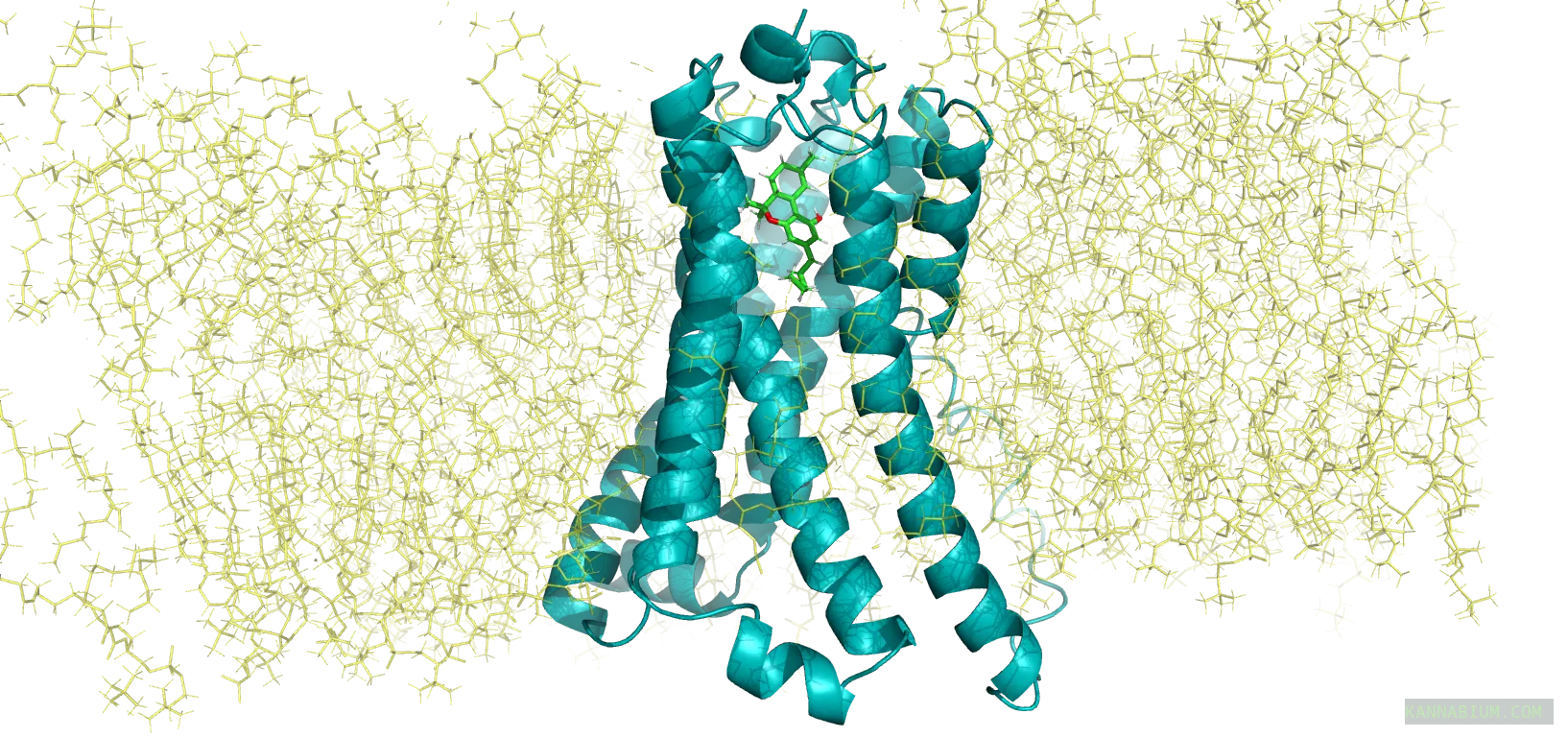
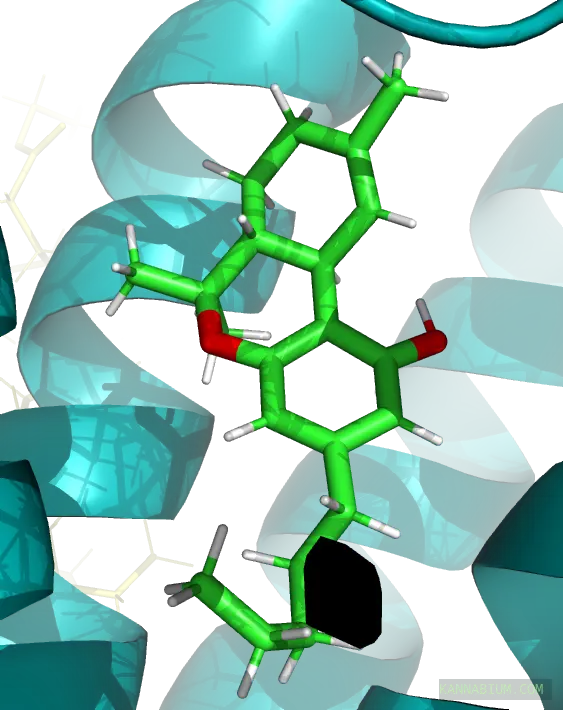
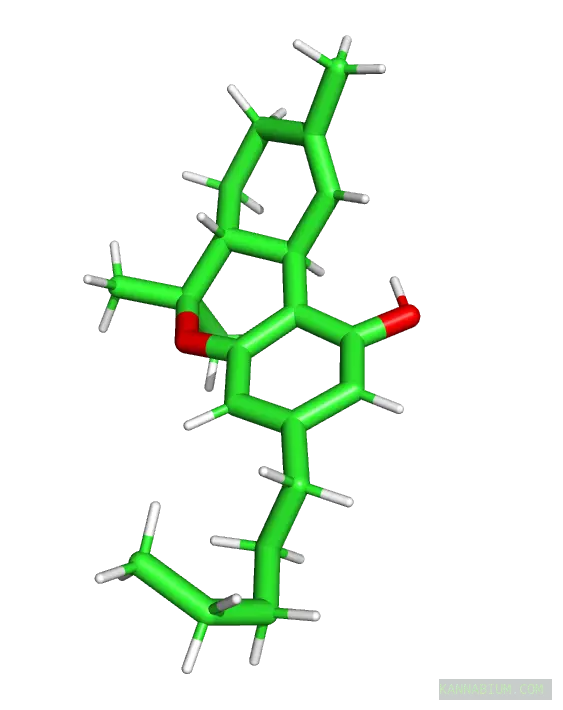
The visual convention uses cyan/teal for CB1R; green carbon, red oxygen, and white hydrogen atoms for THC; and yellow for the membrane. Use the animation to locate the receptor, THC, and membrane in the model. Evaluate stability using the documented trajectory metrics.
MOLECULAR VISUALIZATION
The gallery identifies the receptor, THC, the bilayer, and the orthosteric pocket. The animations show the recorded trajectory segment; stability and convergence must be assessed from metrics.
READING THE IMAGE
The membrane appears as a yellow molecular network; CB1R is rendered in cyan/teal, and THC is highlighted with green carbon, red oxygen, and white hydrogen atoms at the orthosteric site. The image identifies components and spatial orientation but does not demonstrate trajectory convergence.



RECORDED MOTION
The videos show the recorded trajectory segment at two scales. Contacts and displacements must be evaluated from quantitative data, not from the animations alone.
COMPUTATIONAL WORKFLOW
Select a stage to see what was performed, what is available, and what the result cannot establish.
STRUCTURAL PROVENANCE
The local computational directory identifies 5XRA as the receptor source. Its construct, mutations, fragment coverage, and original ligand context remain part of the interpretation.
POSE GENERATION
AutoDock Vina 1.2.5 generated nine modes with exhaustiveness 8 in a 24 Å cubic search box. The best reported score is −11.21 kcal·mol⁻¹.
MEMBRANE PREPARATION
The selected THC pose was combined with POPC/CHL1, TIP3P water, and neutralizing chloride ions. The documented build used 14 Cl⁻ and did not add a target salt concentration.
PRELIMINARY RELAXATION
Minimization, heating to 310 K, NPT stages, and a semi-isotropic membrane stage are present in the local output. Files corresponding to the 300–400 ps window are also available.
OBSERVABLES
RMSD, RMSF, THC heavy-atom RMSD, contacts, and box dimensions were extracted for the 300–400 ps analysis window. “Native contacts” refer to the initial pose definition.
NPT-STAGE MEASUREMENTS
The NPT stage allows the simulation cell to respond while temperature and pressure are controlled. Move through the checkpoints extracted from the local analysis to compare volume, temperature, the Z dimension of the simulation box, and THC–CB1R contacts. Box height includes the membrane and solvent; it is not a measurement of bilayer thickness.
Values are reported checkpoints from the files summary.TEMP, summary.VOLUME, box_dimensions.dat, and contacts_count.dat. The box and contact records are indexed by analysis frame.
RESULTS REGISTER
These values summarize the local record. Verification requires the topology, coordinates, trajectory, and execution files; the docking score is not a measured binding affinity.
kcal·mol⁻¹ · Vina pose 1
ps · preliminary trajectory record
K · equilibration target
0 M added salt concentration
declashed system record; a separate final build contains 98,718 atoms.
reported in the inspected 300–400 ps window.
after CB1R fit in the same window.
the “native” reference is computational, not experimental.
TECHNICAL REVIEW
The files form a traceable preliminary record. Biological interpretation remains limited until preparation choices and sampling have been reviewed.
USES AND EVIDENCE LIMITS
This record can be used to formulate hypotheses about ligand recognition and receptor motion. Evaluating those hypotheses requires experimental assays, longer sampling, and independent simulations.
Computational models can organize hypotheses about recognition, selectivity, conformational change, and ligand–receptor contacts before experimental testing.
Curated structural records can support comparison of poses and interactions, documentation of analytical decisions, and reproducible research-and-development workflows. They do not, by themselves, establish compound efficacy.
Identifying the source of each claim distinguishes simulated results, experimental results, and biological inferences.
INTERPRETIVE SCOPE
Docking proposes a pose hypothesis. Binding affinity and residence time require dedicated experimental or validated computational evidence.
A 300–400 ps analysis window characterizes short-timescale behavior; long-timescale convergence and a unique binding mode require longer, replicated analyses.
5XRA is the local structural source and documents an AM11542-bound experimental context. Evidence for crystallized THC requires a structure obtained with THC under documented experimental conditions.
Read the CB1R molecular-dynamics context · Read the docking interpretation
NEXT · KANNABIUM VIRTUAL LAB
From the documented study to proposed computational experiments.