Biological role
CB1R modulates neurotransmitter release and participates in membrane signaling across central and peripheral physiological contexts. Effects depend on tissue, cellular state, ligand, and experimental design.
BIODEV & DATA CURATION | BIOINFO_ECS
Public platform under continuous technical and curatorial review
Human CB1 receptor biology and selected structures, with evidence limits for signaling and ligand interpretation
OVERVIEW
In Homo sapiens,
cannabinoid receptor type 1 (CB1R) is
encoded by the protein-coding gene CNR1,
located at chromosome region 6q15. The reviewed human protein record
UniProtKB P21554 describes a 472-amino-acid integral membrane
protein in the class A family of G protein-coupled receptors. Its
characteristic topology comprises seven transmembrane segments.
Anandamide (N-arachidonoylethanolamide) and 2-arachidonoylglycerol (2-AG) are among its best-characterized endogenous ligands. CB1R predominantly couples to Gi/o-family G proteins. One major consequence is inhibition of adenylyl cyclase, which reduces the conversion of ATP to cyclic AMP (cAMP). This is not the receptor's only signaling route: CB1R can also modulate ion channels, protein-kinase pathways, and beta-arrestin-dependent responses according to ligand, cell type, and physiological context.
CB1R modulates neurotransmitter release and participates in membrane signaling across central and peripheral physiological contexts. Effects depend on tissue, cellular state, ligand, and experimental design.
Experimentally determined structures capture selected receptor conformations. Comparing inactive, active, ligand-bound, and G-protein-coupled states supports mechanistic interpretation.
EVIDENCE QUESTIONS AND SECTIONS
Use these routes to compare records and structural states before forming an answer. Receptor identity, ligand context, experimental construct, signaling state, and uncertainty must remain connected.
Confirm the organism, CNR1 gene, reviewed protein
record, sequence, topology, orthologs, and relationship to
CNR2.
Compare experimental PDB records, receptor constructs, transmembrane architecture, ligands, conformational states, and associated signaling partners.
Relate orthosteric or allosteric ligand context to receptor activation, Gi coupling, membrane conditions, and the limits of docking-based interpretation.
Signaling context Receptor states Molecular dynamics THC docking
Distinguish observed coordinates and curated annotations from comparative inference, docking poses, simulation, and translational hypotheses.
Structural provenance Simulation limits Analytical limits Interpretive boundary
CURATED PROTEIN RECORD
The record linked below is an external, versioned scientific resource maintained by UniProt. It should be read as a protein record, not merely as an amino-acid sequence. Database annotations can change; record identity and access context must therefore be preserved when a claim is reused.
| Entity | Curated value | Evidence context |
|---|---|---|
| Gene | CNR1 · NCBI Gene 1268 · 6q15 |
Human gene annotation and genomic location |
| Protein | UniProtKB P21554 · 472 amino acids | Reviewed human protein record |
| Receptor class | Class A GPCR · seven transmembrane segments | Curated topology and pharmacological classification |
| Endogenous ligands | Anandamide and 2-AG | Key endogenous ligands; the list is not exhaustive |
Curated against NCBI Gene 1268, IUPHAR/BPS Guide to Pharmacology, and UniProtKB P21554. Sources accessed 12 July 2026.
EXTERNAL CURATED RECORD
Open the current reviewed entry at its source when checking sequence, topology, functional annotations, cross-references, evidence status, or record history.
The external resource opens in a dedicated tab so UniProt can run in its supported browsing context. Confirm the accession and record version before reusing an annotation.
RECEPTOR CLASSIFICATION
CB1 and CB2 are receptor proteins encoded by CNR1 and
CNR2, respectively. Both belong to class A (Rhodopsin) of
the G protein-coupled receptors. In the current GPCRdb hierarchy, they
form the cannabinoid receptor family within the lipid receptors. The
name “Rhodopsin” denotes structural and evolutionary membership in this
GPCR class; it does not mean that CB1 or CB2 detects light.
G protein-coupled receptors
Class A (Rhodopsin)
Small-molecule receptors
Lipid receptors
Cannabinoid receptors
CB1 protein · CNR1 gene
CB2 protein · CNR2 gene
Reactome retains the class A/1 name and summarizes a 2002 analysis that divided rhodopsin-like GPCRs into 19 subfamilies. This scheme explains the terminology in that record, but it does not replace the current GPCRdb hierarchy of class, ligand type, and family.
Membership in the same class supports receptor comparison.
CB1-specific pharmacology and functional conservation across
species require biochemical and physiological evidence. Orthology and the origin of
CNR1 and CNR2 are addressed together in the
evolutionary context.
Current classification: GPCRdb levels and terms ↗ · Receptor nomenclature: IUPHAR/BPS Guide to Pharmacology ↗
CURATED PATHWAY RECORD
Reactome classifies the human CB1 and CB2 receptor binding event within Signal Transduction → Signaling by GPCR → GPCR ligand binding → Class A/1 (rhodopsin-like receptors). The event groups CB1 and CB2 and therefore documents pathway and classification context; it is not evidence specific to CB1.
Source: Reactome R-HSA-419426. Cross-check receptor nomenclature with the IUPHAR/BPS cannabinoid receptor family.
EVOLUTIONARY CONTEXT
An ancestral gene related to CB1 and CB2 preceded the duplication that
produced CNR1 and CNR2 in vertebrates. This page
focuses on CNR1 and the CB1 protein it encodes. BfCBR in
Branchiostoma and CiCBR in Ciona help reconstruct the stage
before that duplication, but they are not called CB1 or CB2 without
qualification.
CNR1 encodes CB1 and CNR2 encodes CB2. The
two genes descend from an ancestral duplication and are paralogs;
their shared origin does not make the receptors functionally
equivalent.
Across vertebrates, CNR1 orthologs are the appropriate
reference for comparing CB1 sequence, structure, and expression.
Pharmacological or physiological conservation must be tested
separately.
INFERENCE LIMIT
The evolutionary tree describes ancestry and duplication events. Determining ligands, expression patterns, and physiological roles requires functional evidence for each receptor.
cb1-cb2-evolution Species tree · gene duplication · evidence · primary references Open analysis ↗
STRUCTURES
These selected records provide inactive and active receptor structures, a G-protein complex, an endocannabinoid-analog complex, and an allosteric-modulator context. Comparisons require attention to ligand identity, construct, method, and resolved regions.

Structural coordinates are obtained from the cited PDB records and rendered locally with 3Dmol.js. Use the official RCSB PDB Mol* viewer. Entry metadata accessed 12 July 2026. Experimental structures are snapshots produced under specific constructs and conditions; compare method, resolution, mutations, ligands, and validation reports before drawing mechanistic conclusions.
| PDB | Ligand | Comparative role |
|---|---|---|
| 5TGZ | AM6538 | Inactive antagonist-bound state |
| 5XRA | AM11542 | Active agonist-bound state |
| 5XR8 | AM841 | Active agonist-bound state |
| 5U09 | Taranabant | High-resolution inactive reference |
| 9B54 | VIP36 | Biased agonism in a CB1–Gi complex |
OBSERVATION GUIDE
The panel above lets you switch between PDB records, examine one structure at a time, and consult its metadata. The questions below guide visual reading; they do not trigger an automated comparison.
01 · INACTIVE STATES
How do AM6538 and taranabant occupy the orthosteric pocket and stabilize experimentally observed inactive conformations?
Differences may reflect ligand, mutations, fusion partners, construct design, and crystallographic conditions.
Record: pocket residues, ligand pose, and one construct-related limitation.
02 · AGONIST EFFECTS
Which contacts and pocket rearrangements are shared or ligand-specific for AM11542 and AM841?
Structural differences alone do not establish differences in efficacy, potency, or physiological response.
Record: shared contacts, distinct contacts, and the evidence needed to test efficacy.
03 · SIGNALING COMPLEXES
How do receptor activation, Gi coupling, ligand context, and the biased-agonist complex differ among these snapshots?
Biased agonism depends on assay, pathway, cellular context, reference ligand, and quantitative transduction analysis.
Record: receptor state, Gi interface, ligand context, and an assay-dependent question.
04 · BINDING SITES
Where is the allosteric site relative to orthosteric ligands, and which conformational connections are plausible?
Spatial proximity or conformational difference does not by itself establish physiological allosteric efficacy.
Record: site location, connecting residues, and a testable allosteric hypothesis.
MOLECULAR DYNAMICS
Molecular dynamics (MD) is a computational simulation method used to study the movement and interactions of atoms and molecules over time.
THEORETICAL FOUNDATION
MD numerically integrates Newton's classical equations of motion for a system of N particles. For atom i, the force is obtained from the negative gradient of the system's potential-energy function:
Record the construct, ligand, missing or mutated residues, membrane lipids, solvent, ions, protonation states, and starting coordinates before interpreting molecular motion.
Minimize and equilibrate before production. The integrator, time step, ensemble, temperature, pressure, force field, and independent replicates must remain explicit.
Compare conformations, fluctuations, ligand contacts, water networks, and transmembrane-helix rearrangements across replicates and against experimental receptor states.
| Field | Governed value | Evidence status |
|---|---|---|
| Candidate source structure | 5U09 · human CB1R · inactive state · 2.6 Å | Identity, method, and resolution: archive facts; inactive state: curated interpretation; trajectory derivation: unconfirmed |
| Bound ligand | 7DY · taranabant · inverse agonist | Presence observed; pharmacological role externally annotated; not THC |
| Simulated environment | POPC membrane · TIP3P water · sodium · chloride | Observed in local PDB and PSF |
| System size | 69,095 atoms | Local PSF |
| Force-field family | CHARMM36 family with ligand-specific topology | Topology sources inferred from PSF remarks; production parameters unavailable |
| Protocol | Software, duration, time step, ensemble, conditions, and replicates unavailable | Not documented locally |
DOCKING · CHANGE OF CASE STUDY
Docking proposes testable binding poses within a selected receptor structure; it does not demonstrate binding or efficacy by itself. Molecular dynamics can then test whether a modeled pose relaxes, persists, or shifts under the chosen simulation conditions.
FUNCTIONAL CONTEXT
In the cited functional evidence, THC can activate CB1R while producing a lower maximal response than a high-efficacy full agonist in a particular assay. This does not mean partial receptor occupancy or necessarily weak binding. Apparent efficacy depends on the measured pathway, receptor density and reserve, biological system, assay conditions, and comparator.
Functional evidence: IUPHAR/BPS Guide to Pharmacology · primary CB1R assay study.
Read the evidence in three layers. A result in one layer does not replace evidence required in the others.
Identify the assay, measured pathway, full-agonist comparator, and receptor context that support the partial-agonist classification.
Does the ligand shape fit the selected receptor state without unsupported assumptions about efficacy?
Which contacts, waters, and pocket rearrangements remain reproducible across independent simulations?
CONCLUSION
CB1R is used here as the receptor-side case study for vertebrate biology, signaling, and ligand-bound structural states.
Structural states and functional assays answer different questions. Compare the ligand, construct, experimental method, and limits of each evidence record.
Return to Cannabis sativa for the species frame or use the docking section to evaluate hypotheses about THC–CB1R binding.
The species, enzyme, phytochemical, and receptor pages form an evidence network with distinct scopes. Conclusions should preserve the identity, method, and limitations of each record.
COMPUTATIONAL STUDY · CB1R–THC
Consult structural data, THC docking, membrane molecular dynamics, and documented visualizations, with the interpretation limits of each result.
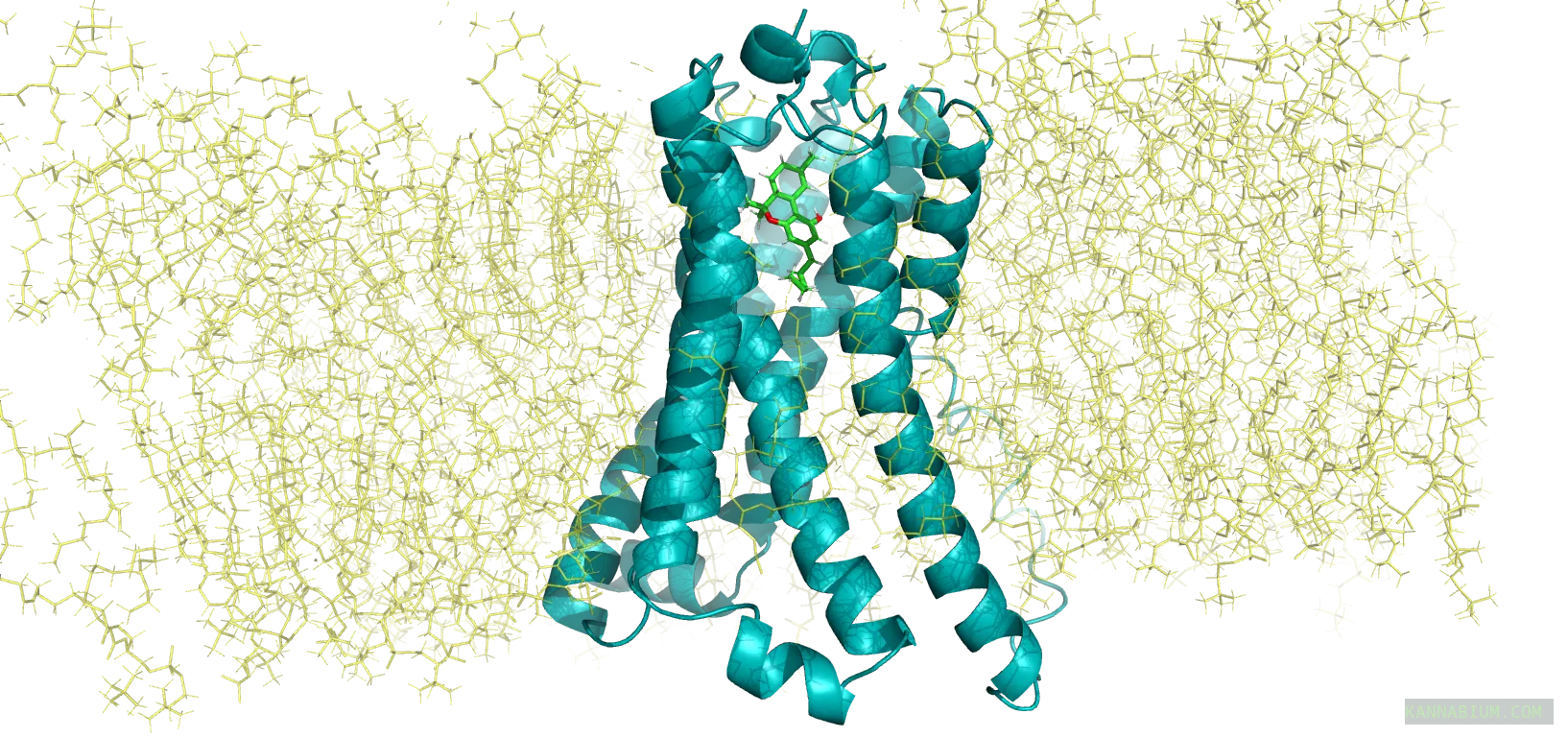
Review the visual evidence, trajectory boundaries, and documented workflow for the CB1R–THC system.
A study for consultation, not an interface for running new simulations.
REUSING AN ANALYSIS
Record the organism, the CNR1 gene, the protein-record
accession, and the ligand in each selected structure. Check whether
the construct contains mutations or other experimental modifications.
Record the PDB accession, version, chain, selected residues, annotation source, and visualization or analysis parameters.
Identify whether a result comes from an experimental structure, a THC docking pose, a simulated trajectory, or a functional assay. State which source supports each conclusion and the limits of comparison between these results.