Sequence record
NCBI
Sequence records identify nucleotide or protein material and its version. Gene, locus, and variants must be checked in the corresponding genomic records; a protein sequence alone does not contain all of this information.
BIODEV & DATA CURATION | BIOINFO_THCA
Public platform under continuous technical and curatorial review
An evidence-based reading of an enzyme in Cannabis sativa cannabinoid biosynthesis
Open the 3D viewerThe THCAS gene encodes THCA synthase in Cannabis sativa. The enzyme converts CBGA into THCA. The biochemical reaction, the deposited experimental structure, and computational interpretations are presented as distinct evidence layers.
Follow the reasoning in this order: confirm identity and reaction; inspect the structure, cofactor, and residues; then evaluate hypotheses, provenance, and limitations. The glossary defines the essential terms used along this path.
PAGE GLOSSARY
These definitions explain how each term is used on this page. They support reading but do not replace the cited records and articles.
Q&A EVIDENCE MAP
Follow these routes to assemble an answer rather than relying on a single paragraph. Each route connects molecular identity, structural observations, functional interpretation, and explicit evidence boundaries.
Confirm the organism, enzyme record, protein-record accession (the identifier assigned to the protein entry), construct, locus context, and reported sequence variation.
Inspect the experimental record, construct, structural partitions, FAD, catalytic residues, and unresolved limits.
Relate the oxidative reaction to the proposed catalytic roles of FAD and selected residues without treating a static structure as a complete mechanism.
Separate sequence annotation, experimental coordinates, predictive models, mechanistic interpretation, and hypotheses.
ENZYME FUNCTION · EC 1.21.3.7
The structural record provides the experimental anchor for this page. Its associated protein reference is UniProt Q8GTB6, while BRENDA supplies the complementary enzyme classification and reaction record.
The equation follows IUBMB EC 1.21.3.7 and names the carboxylate forms. The introductory glossary uses the corresponding acid names.
Evidence boundary. The molecular geometry and residue interpretation on this page derive from that record. The reaction classification is complementary functional evidence and does not replace the structural record.
The RCSB Protein Data Bank maintains the structural record used on this page. To make the analysis verifiable, cite the structural identifier shown in the record below, the original authors, and the repository; keep protein and reaction references distinct.
| Organism | Cannabis sativa L. |
|---|---|
| Protein | THCA synthase |
| Protein reference | UniProt Q8GTB6 |
| Structure | PDB 3VTE |
| Structure coverage | Chain A, UniProt residues 28–545 |
| Experimental method | X-ray diffraction, 2.75 Å resolution |
| Enzyme classification | EC 1.21.3.7 |
| Reaction | Cannabigerolate + O2 → Δ9-tetrahydrocannabinolate + H2O2 |
| Cofactor | FAD |
| Curatorial fields | Source, evidence level, review status, and notes |
| Traceability | PDB, UniProt, and BRENDA identifiers, publication record, and retrieval history |
Each record answers a different question: sequence identifies the protein, a predicted fold offers a model, and the experimental record provides experimentally derived coordinates under defined conditions.
Sequence record
Sequence records identify nucleotide or protein material and its version. Gene, locus, and variants must be checked in the corresponding genomic records; a protein sequence alone does not contain all of this information.
Predicted model
This model provides a predicted fold and local confidence estimates. It can guide structural questions but does not measure molecular flexibility or replace experimental coordinates.
Experimental structure
This experimentally determined coordinate model reports observed geometry and cofactor placement under specific conditions. It is a primary source for structure-informed interpretation, not a complete account of function or molecular dynamics.
The experimental coordinate model lets readers inspect the cofactor, residue context, and proposed catalytic regions alongside the biochemical literature.
The enzyme catalyzes the oxidative conversion of cannabigerolic acid into tetrahydrocannabinolic acid in Cannabis sativa. The structure can support discussion of FAD chemistry, residue context, substrate access, and why static models are one part of the scientific picture.
The legend and residue ranges below are grounded in the local PDB copy and the project modeling notes. The 502-residue count refers to polymer residues modeled with coordinates, while the domain bands follow the modeling partition used for visualization.
The local 3VTE.pdb file contains 502 modeled residues, 4,211 atoms, and highlights NAG (6) and FAD (1).
Structural inspection
Inspect FAD, anchors 114/176, ASA-loop, Ala116 (chain A), and Gly376/Ser448. Compare their positions with the annotations and cited biochemical sources.
Structural interpretation key
Modeling references
The interactive workbench below allows readers to inspect these annotations and generate a PyMOL script.
The preceding sections examine the reaction and experimental structure. This dossier adds genomic organization, synthase evolution, trichome expression, marker applications, and primary references.
In the genome assemblies discussed by the cited mapping studies, THCAS- and CBDAS-family loci occur in a repetitive region associated with chemotype. Historically, THCA and CBDA production was interpreted through a simple Mendelian B-locus model, with BT for THC and BD for CBD. Current genomic models add copy-number variation, haplotype structure, transposable elements, and assembly-specific coordinates. Locus size, chromosome placement, and recombination estimates should therefore be reported with the cultivar and reference assembly.
Cannabinoid synthases belong to the berberine bridge enzyme-like family. Villard et al. (2026) inferred ancestral sequences and tested enzymes produced from them. Reconstructed ancestral enzymes showed catalytic promiscuity: they converted CBGA into more than one product — THCA, CBDA, and CBCA — in vitro. These assays support hypotheses about ancestral function; they did not test an enzyme recovered from ancient plant remains. The study relates later specialization to gene duplication and diversification. Archaeobotanical and phytochemical evidence from ancient plant remains can inform the history of human use, but it does not by itself identify modern THCAS alleles or establish an ancestral enzyme function.
Expression studies cited for this module report THCAS enrichment in secretory disk cells of glandular trichome heads, especially in female inflorescences. The following findings come from distinct regulatory studies and should not be treated as one experimentally validated circuit:
Distinguishing potentially functional and nonfunctional THCAS copies can support breeding and jurisdiction-specific compliance workflows. Methods such as RFLP and high-resolution melting analysis (HRM) use selected polymorphisms to estimate chemotype during the vegetative stage. These markers are predictive rather than definitive and should be interpreted with copy number, haplotype, cultivar, growth conditions, and measured cannabinoid profiles.
Each reference below links to its verified DOI or original publisher record. Titles are presented in full so visitors can identify the evidence before opening the source.
The interactive workspace combines the experimental record, residue annotations, and a PyMOL script generator. Each annotation separates what is observed in the model from biochemical interpretation.
Visualization locates residues and the cofactor but does not measure enzyme activity. Consult the cited experiments when interpreting each position.
Interactive workstation
Use the reference structure as a transparent starting point for molecular inspection. Select the features to emphasize, generate a reproducible PyMOL script, and carry the result into a documented curation workflow.
.pml file for PyMOL.Generated script
Interactive molecular inspection
Select a curated residue or click an atom. The explorer locates the selection, separates structural observation from functional interpretation, and reports the supporting source.
Structure appearance
Choose the colors. The 3D view and PyMOL script update without reloading the structure.
Colors will be applied when the 3D view is activated.
PNG: 2400 × 1800 px.
Source, citation, and rights for the exported image: structural data from PDB 3VTE (DOI 10.2210/pdb3VTE/pdb), made available by wwPDB under CC0 1.0. Structural interpretation based on Shoyama et al. (2012). Visual composition © 2026 Kannabium. The PNG includes the source, article, license, colors, and active selection.
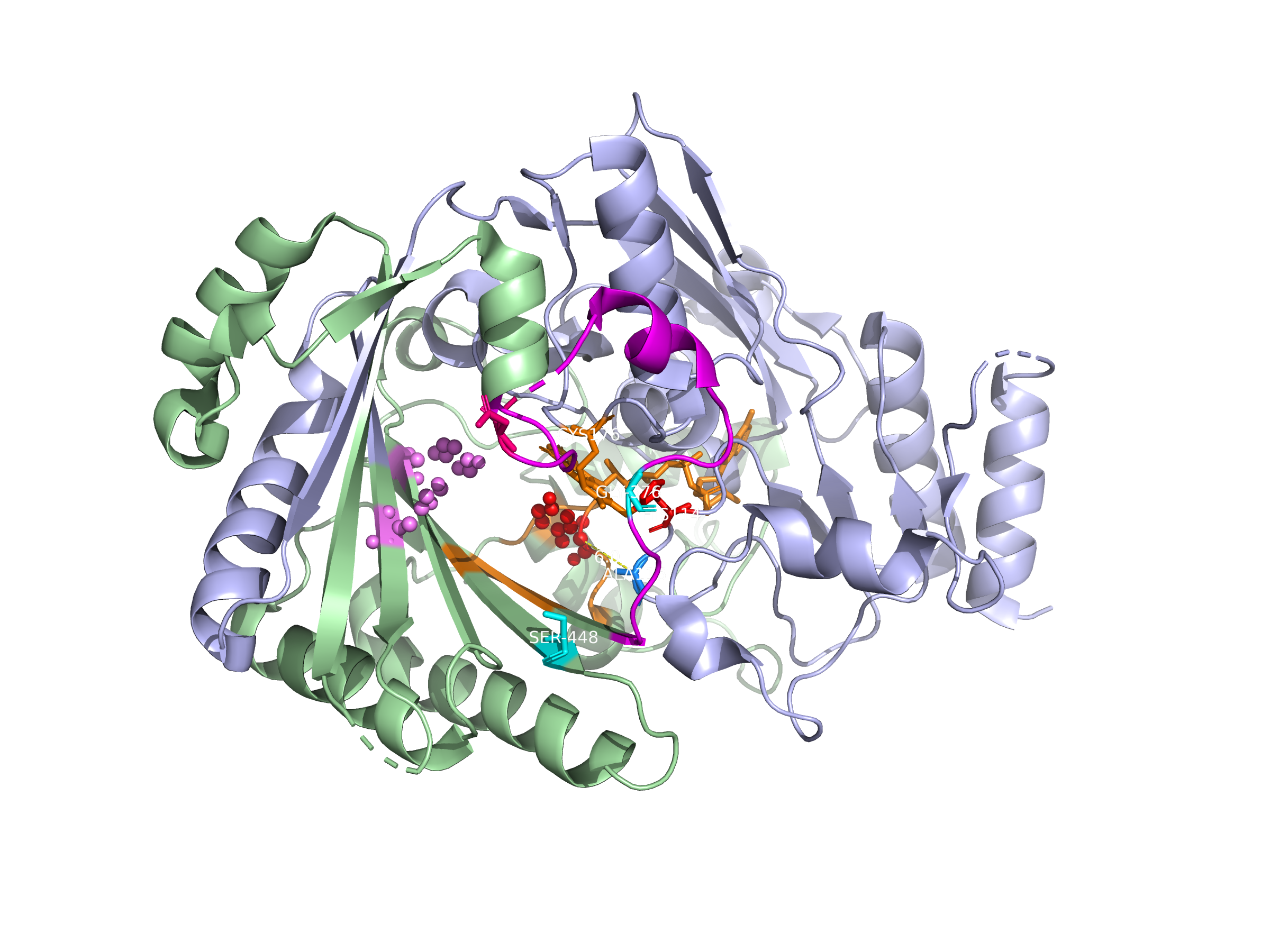
Drag to rotate, scroll to zoom, and click an atom to inspect its residue. The spatial label follows the selected residue.
His114 and Cys176 have covalent links to FAD recorded in 3VTE; Tyr484 has a proposed catalytic role. Gly376 and Ser448 are comparison positions with no catalytic role assigned on this page.
Viewer summary
Use this minimal template for manual work without a connection. To reproduce the selections made on this page, download the script from the generator above.
load 3VTE.pdb
hide everything
show cartoon, polymer.protein
color forest, polymer.protein
select fad, resn FAD
show sticks, fad
color yellow, fad
zoomThe structure is an experimental model, but its interpretation remains bounded by resolution, sample preparation, and the evidence available for function.
Document model quality, parameters, sampling, and data provenance; interpret results alongside literature, sequence analysis, enzymology, and pathway data.
CONCLUSION
THCAS encodes an enzyme that converts CBGA into THCA, and the Protein Data Bank contains an experimental structural model of that protein.
Mechanistic steps, variant effects, and functional consequences require biochemical, genetic, or cellular data.
Compare residues and hypotheses with the cited studies, recording the source, method, and limit of each conclusion.
In the wider reading path, THCA synthase supplies the plant-side enzymatic step that connects Cannabis sativa to THCA biosynthesis. The separate CB1R module adds a vertebrate pharmacological context; it is not part of the plant biosynthetic pathway and does not imply direct cross-kingdom coevolution.
Its value as a teaching case lies in reading a plant enzyme through its sequence, structure, biochemical evidence, and unresolved questions.
NEXT · KANNABIUM VIRTUAL LAB
From structural evidence to proposed molecular experiments.
REUSING AN ANALYSIS
Record Cannabis sativa, the protein-record accession UniProt Q8GTB6, and the PDB structure 3VTE. Identify the construct and chain used in the analysis.
Record the PDB version, selected residues, cofactor, annotation source, and visualization or analysis parameters. Save the generated PyMOL script with these records.
Distinguish the coordinates and bonds observed in 3VTE from proposed catalytic roles. Cite the biochemical assay or comparative study that supports each claim about enzyme function or evolution.